Every post, newest first. Short — we would rather build than describe.
Grant watch: up to PLN 8,000 for rainwater harvesting at home
The "Mikroretencja" programme (successor of "Moja Woda") refunds up to 90 % of the cost of rainwater tanks, infiltration systems and garden irrigation — max. PLN 8,000, minimum 2 m³ of tanks and 50 m² of roof, costs incurred since 1 July 2024. Applications are electronic only, for completed installations, until end of 2027 or until funds run out. In Podkarpacie the regional fund holds PLN 19.1 million and only about 25 % had been used by summer — the pool is still open. Details: gov.pl/web/nfosigw/mikroretencja.
PV Designer now picks the inverter and lays out the strings
Our free PV Designer now ships a catalogue of 116 inverters (FoxESS, Huawei, Deye, Growatt, SolaX) built from Polish datasheets, with certificates from the PTPiREE register. Once panels are placed on the roof, the designer lists only inverters that match the array power and phase count, and "Auto-select" picks a model with no warnings. Strings are sized the way an experienced installer does it: voltage at −25 °C frost must stay under the inverter limit and must not drop below the MPPT window in summer; each roof plane gets its own MPPT input. The map shows which panel belongs to which string (S1.1, S1.2…), and the single-line diagram and the PGE grid-connection form are built from the same data. Still free, in the browser, no sign-up.
First customers list is open
Sales haven't started yet — but you can already join the free sample list. Restaurant, shop or home: drop us a line and we'll reach out with a sample before launch. Look for the "Join the sample list" button in the farm-factory section.
PV Designer now uses Poland's official government maps
Our free PV Designer now taps Poland's national geodetic services (GUGiK). Three additions: the official aerial orthophoto as a third base map next to Google — in rural areas it is usually sharper and more recent than satellite imagery, so you can actually see the roof; a "Parcel" mode — click a point on the map and the designer fetches cadastral parcel boundaries and number from the ULDK service; and address search in the national address registry (PRG) — when Google does not know a house number (common in the countryside), the official registry does. Still free, in the browser, no sign-up — public data combined with the convenience of one app.
NASA grows microgreens in space — we do it in Stalowa Wola
In the Veggie module aboard the International Space Station, NASA astronauts grow microgreens and leafy greens — in a controlled environment, under LED light, with every parameter measured (the Advanced Plant Habitat chamber has over 180 sensors). Why microgreens? They take little space, mature in 10–14 days and pack concentrated nutrients — while vitamins in prepackaged food degrade over a mission. That is exactly the principle of our factory-farm: a closed, instrumented environment and a steered flow of energy — just here, in Stalowa Wola. Photo: NASA. More: Growing Plants in Space — NASA.
V6M is being born — a family technology company
V6M is starting up in Stalowa Wola, Poland: a family company combining vertical microgreens farming, its own software and solar energy in one closed loop. The farm-factory is under preparation and the company registration is under way. More soon.
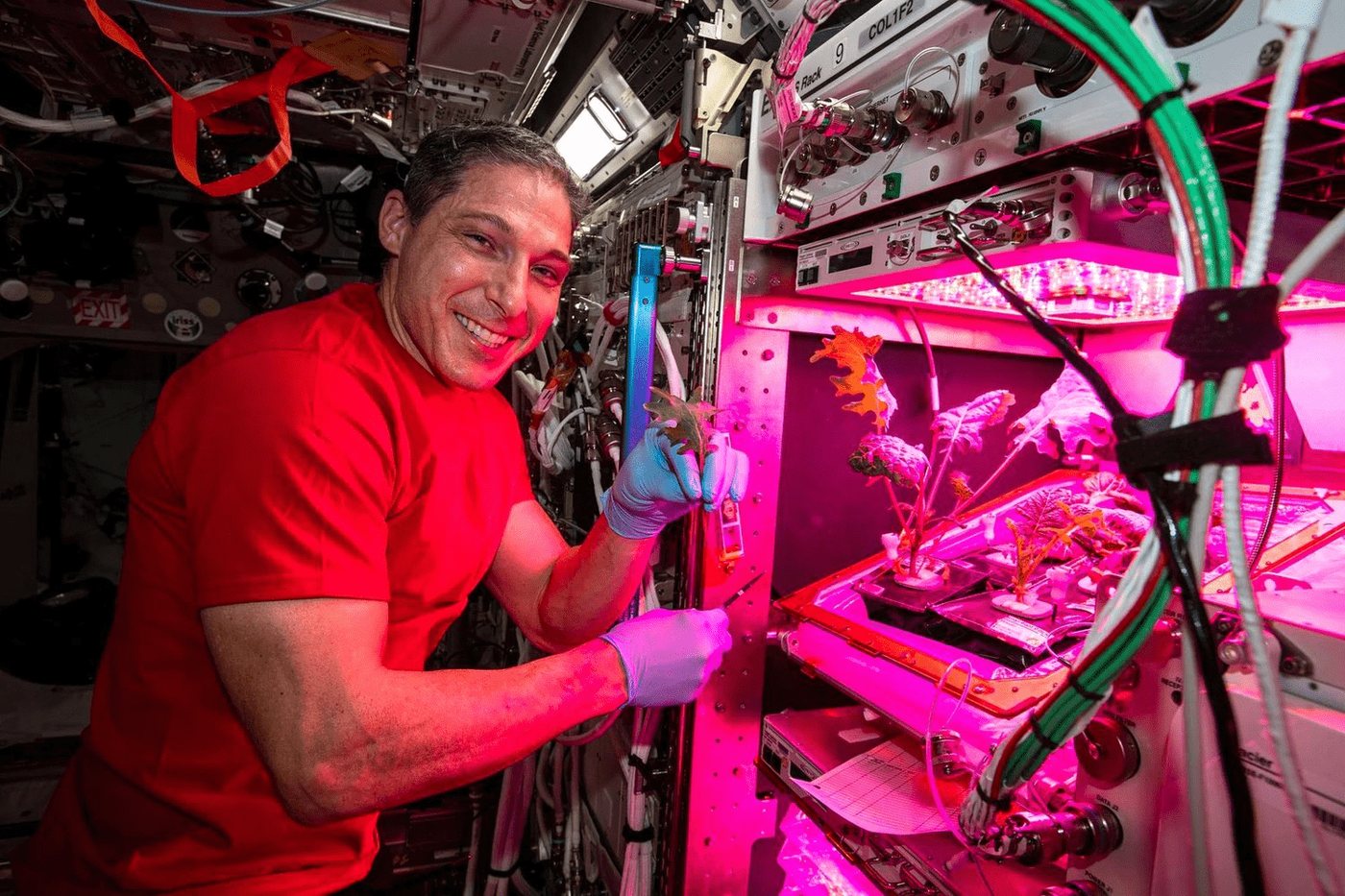 In the Veggie module aboard the International Space Station, NASA astronauts grow microgreens and leafy greens — in a controlled environment, under LED light, with every parameter measured (the Advanced Plant Habitat chamber has over 180 sensors). Why microgreens? They take little space, mature in 10–14 days and pack concentrated nutrients — while vitamins in prepackaged food degrade over a mission. That is exactly the principle of our factory-farm: a closed, instrumented environment and a steered flow of energy — just here, in Stalowa Wola. Photo: NASA. More: